Pre-Development Preparation
Before starting development, you need to complete the following preparation work to obtain necessary accounts and parameters.
Obtain Developer Account
Tip: If you are already a SUNBAY customer, you can directly use your existing account to log in to the Copilot portal.
-
Contact SUNBAY
- Contact SUNBAY sales team or account manager
- Provide basic business information and qualifications
- Explain your business scenario and integration requirements
-
Submit Application Materials
- Business registration certificate
- Business owner identification
- Business scenario description
- Expected transaction volume
-
Wait for Review
- Review time is usually 1-3 business days
- You will receive an email notification after approval
- The email contains login credentials and initial password
Create Payment Application
What is an Application?
An application is a logical entity you register on the SUNBAY platform to identify an independent client or server access point (such as POS system, mobile app, web site, etc.). Each application has a globally unique App ID and dedicated security credentials (API Key / Secret) for request authentication and permission isolation.
Why Must You Create an Application?
- Identity Identification: The system identifies the caller through App ID to ensure request source is traceable
- Security Isolation: Each application uses independent keys to avoid credential leakage causing platform-wide risks
- Configuration Granularity: Supports configuring function permissions and rate limiting policies per application
- Environment Isolation: Sandbox environment and production environment use independent application configurations that do not affect each other
Log in to the Copilot portal to create a payment application:
-
Log in to Copilot
- Use the credentials from the email to log in
- First login requires password change
- Enable two-factor authentication
-
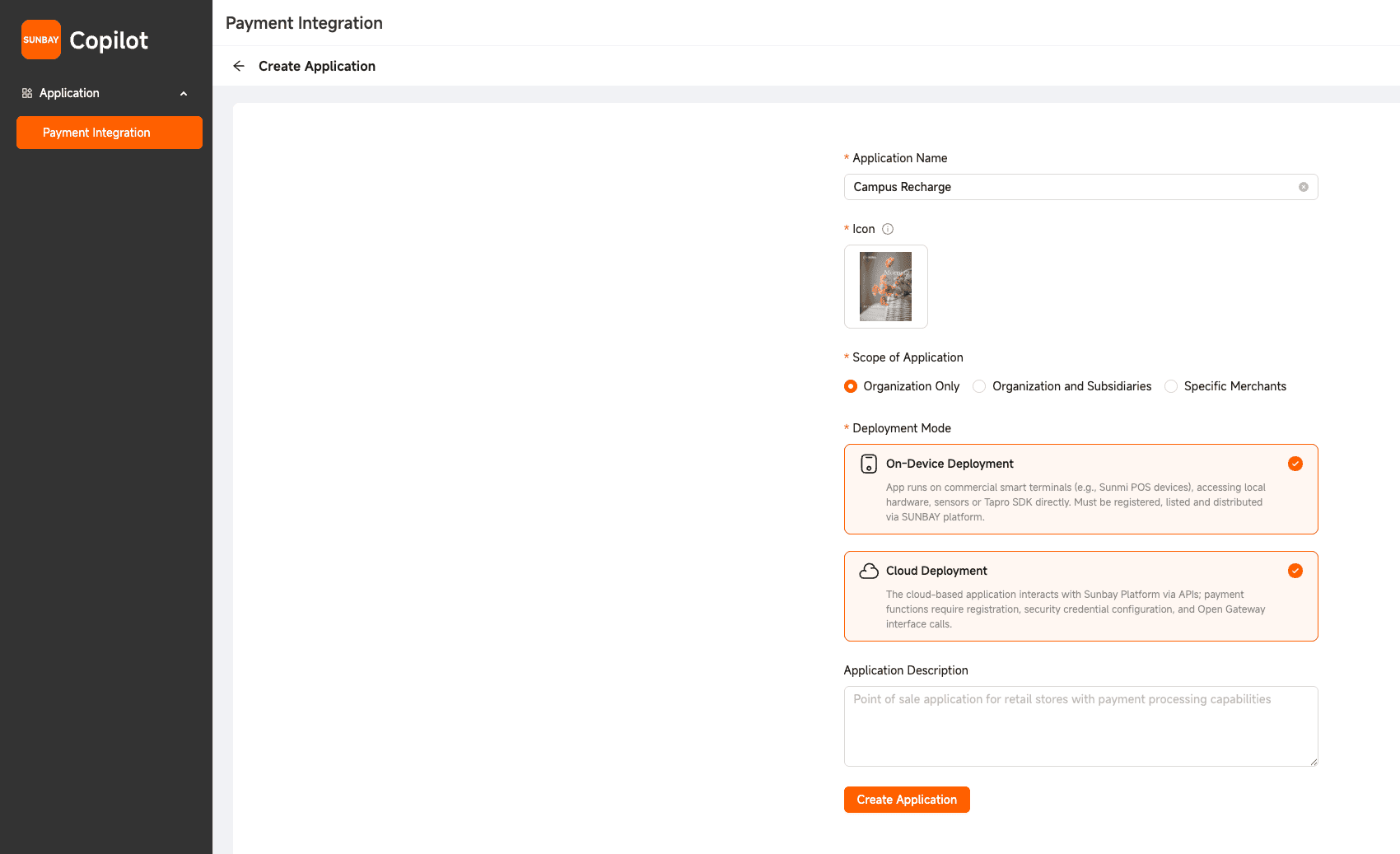
Create Application
- Go to “Developer” → “Application List”
- Click “Create Application”
- Fill in application information:
- Application Name: Application name (e.g., My POS Application)
- Icon: Upload application icon (supports PNG, JPG, etc.)
- Scope of Application: Application scope
- Organization Only: Only for this organization
- The organization and subsidiaries: This organization and subsidiaries
- Specific Merchants: Specific merchants
- Deployment Mode: Deployment mode
- On-Device Deployment: Terminal deployment (Tapro SDK integration)
- Cloud Deployment: Cloud deployment (Cloud API integration)
- Application Description: Application description
Obtain Sandbox Parameters
After creating the application, the system will automatically generate sandbox environment parameters:
-
Test Application ID
- Test App ID: Application identifier dedicated to sandbox environment
-
Test Merchant ID
- Test Merchant ID: Test merchant number
-
Test Keys
- Includes server authentication, terminal authentication, Webhook signing and other keys
- Click “Show Secret” to view complete keys
- Please keep them safe and do not leak
-
Sandbox Server Address
- UAT API Base URL: Sandbox environment API base address
Security Tips:
- Do not commit API Secret to code repository
- Do not hardcode keys in client code
- It is recommended to use environment variables or key management services for storage
- Regularly rotate API keys
Checklist
After completing environment preparation, please confirm the following items:
- ✅ Obtained Copilot account and successfully logged in
- ✅ Created payment application
- ✅ Obtained test keys
- ✅ Obtained test merchant ID
- ✅ Obtained sandbox server address
Complete! After completing pre-development preparation, you can start Sandbox Environment Testing.
FAQ
What if I forget the API Secret?
You can view it again in Copilot, but secondary authentication is required to ensure security.
Are sandbox environment and production environment parameters the same?
No. Sandbox environment and production environment use different Test App ID, API Secret, and Test Merchant ID. You need to switch to production environment parameters before going live.
Application deployment mode: What is the difference between terminal deployment and cloud deployment?
- Terminal Deployment (On-Device Deployment): Uses Tapro SDK integration, payment logic runs on POS terminal or mobile device, suitable for offline store scenarios
- Cloud Deployment (Cloud Deployment): Uses Cloud API integration, payment logic runs on your server, suitable for e-commerce platforms, online stores, etc.
Why can only one application deployment mode be selected?
Most businesses’ online and offline payment scenarios are independent of each other. Even if your business involves both online and offline, we recommend creating independent applications for different scenarios, which can:
- Reduce system complexity, facilitate maintenance and troubleshooting
- Achieve more granular permission control and configuration management
- Avoid confusion of transaction data from different scenarios
One business can correspond to multiple applications, flexibly configured according to actual scenarios.
Can I create multiple applications?
Yes. You can create multiple applications for different business scenarios or clients, each with independent credentials and permission configurations.